AI can improve recruitment efficiency—but it can also introduce new risks: bias, privacy issues, poor transparency, and over-reliance on automation.
The safest path is to treat AI like any other high-impact system: define the purpose, control the data, measure outcomes, and keep humans accountable. The technology is only as good as the process around it, so the organisations that get value from AI in recruitment are usually the ones that already run disciplined hiring and apply the same governance discipline to the tools they adopt.
Exploring technology-enabled workforce solutions? See technology solutions.
Key takeaways
- AI should support recruitment decisions, not replace accountability for high-impact outcomes.
- Governance needs clear decision scope, human-in-the-loop rules, data controls, and ongoing monitoring.
- Bias testing is not a one-off—repeat it after model updates and process changes.
- AI performs best when core recruitment processes are already strong (role clarity, structured interviews, onboarding, KPIs).
- Document how each tool is used and tested, so you can explain decisions and respond if a candidate or regulator asks.
Common AI use cases in recruitment (and what to watch)
Job ad creation and optimisation
- Benefit: faster content creation and iteration, which helps teams test wording and refresh stale ads without waiting on copywriting.
- Risk: biased language or misleading claims if not reviewed, including subtle wording that can discourage some candidates from applying.
Resume screening and ranking
- Benefit: speed and consistency, particularly across high-volume roles where manual screening is slow and uneven.
- Risk: bias amplification if historical data reflects biased hiring patterns, which can quietly reproduce past disadvantage at scale.
Chatbots and candidate communication
- Benefit: quicker responses and improved candidate experience, with consistent answers to common questions at any time of day.
- Risk: incorrect information, poor handover to humans, and accessibility issues for candidates who need a different channel.
Scheduling and workflow automation
- Benefit: reduces administration time and frees recruiters to focus on judgement-heavy work like assessment and engagement.
- Risk: lower decision risk, but still requires privacy and security controls because it handles candidate data.
The governance framework (practical checklist)
1) Define the decision you’re automating
- What decision is the AI supporting?
- What decisions must stay human-only?
- Is the tool informing a decision, or effectively making one on its own?
2) Set a “human in the loop” rule
- Who reviews outputs?
- When can a recruiter override the tool?
- How are overrides logged and learned from?
3) Control data and privacy
- What candidate data is collected?
- Where is it stored and processed?
- Who has access?
- How long is it retained?
Collect only the candidate data the tool actually needs, and be clear about where it goes once collected. The more personal information an AI system touches, the larger the privacy and security obligation, so a simple data map—what is collected, where it sits, who can see it and when it’s deleted—makes the rest of your controls far easier to stand behind.
4) Test for bias and adverse impact
- Compare outcomes across groups where appropriate.
- Validate that outputs do not systematically disadvantage certain candidates.
- Repeat testing after updates or model changes.
Bias testing is most useful when it’s built into the process rather than treated as a launch-day formality. A model can behave differently as the candidate pool shifts or as the vendor retrains it, so set a cadence for re-testing and keep a record of what you checked and what you found.
Bias testing and safe processes also support culturally safe recruitment practices. See culturally safe recruitment.
5) Ensure transparency and explainability
- Can you explain why candidates were shortlisted or rejected?
- Can candidates get a meaningful response if asked?
If you can’t explain in plain language why a candidate was shortlisted or screened out, that’s a sign the tool is making a decision you can’t stand behind. A useful test is whether a recruiter could give a fair, honest answer to a candidate who asks why they didn’t progress. Tools that operate as a black box are harder to defend and harder to improve, because you can’t see what drove the outcome.
6) Vendor due diligence (if using third-party tools)
- Security posture and certifications
- Data residency and subcontractors
- Model update process
- Incident response and audit support
7) Monitor outcomes continuously
Track:
- Time-to-fill
- Quality signals (retention, hiring manager satisfaction)
- Candidate drop-off rates
- Complaint/escalation volume
How AI fits into a broader workforce program
AI works best when your underlying processes are already strong: clear role definitions, structured interviews, consistent onboarding, and measurable KPIs. Adding automation to a vague or inconsistent process tends to make it faster, not better, because the tool simply scales whatever logic and data you feed it. The more sensible sequence is to fix the fundamentals first, then layer AI on top to remove genuine friction—and to keep a named owner accountable for how each tool performs over time.
Related services
FAQ
Is AI recruitment legal in Australia?
Legal obligations depend on the tool, how it’s used, and how data is handled. Get advice for your situation and document governance and testing. Privacy, anti-discrimination and employment obligations can all be relevant, so the safest approach is to treat AI tools as in scope for the same compliance review you would apply to any system handling candidate information.
Should AI decide who gets interviewed?
In most organisations, AI should support decisions, not replace accountability. Keep humans responsible for high-impact decisions.
How often should we re-test for bias?
Treat it as ongoing rather than one-off. Re-test after model updates, process changes or shifts in your candidate pool, and keep a record of what was tested so you can show your governance is active rather than assumed.
Next step
If you want to implement technology-enabled recruitment safely, explore technology solutions.
General information only: this article provides general information and is not legal advice.
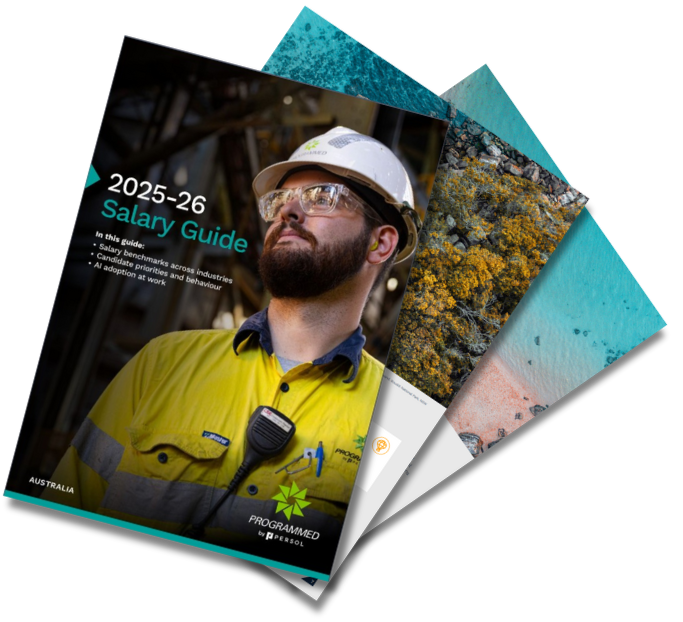
Know the Market Rate
Whether you’re comparing job offers or benchmarking pay for your workforce, the 2025-26 Salary Guide covers current rates across Australian trades and industrial roles.
Download the 2025-26 Salary Guide →