A career change into mining or resources can be achievable, but it’s not usually about a single “magic ticket”.
Most people succeed by choosing an entry pathway that matches their current skills, getting genuinely site-ready, proving reliability and safety mindset, and building experience step-by-step. Plenty of workers move across from construction, manufacturing, transport, defence, agriculture and the trades every year, so a non-mining background is rarely the barrier people assume it is. What slows most people down is buying tickets that don’t match the roles they’re actually applying for, or underestimating what a roster commitment really involves once travel and fatigue are factored in.
Ready to start looking? Search current roles: Programmed jobs search
Key takeaways
- Pick an entry role family that matches your current skills (don’t buy tickets “just in case”).
- “Site-ready” matters: documents, tickets, availability, and roster tolerance.
- Reliability and safety mindset are assessed as much as technical skills.
- Mobilisation can move fast—keep digital copies of documents ready.
- Be realistic about roster commitment early; a roster mismatch is one of the most common reasons new starters drop out.
Step 1: Choose a realistic entry pathway
Start by mapping your current experience to role families such as:
- Trades and maintenance (qualified trades). If you already hold a recognised trade, this is often the most direct entry point because your qualification transfers and sites are frequently short of fitters, electricians, boilermakers and similar roles.
- Trades assistant / shutdown support roles. These can be a realistic first step for people without a trade, giving you on-site exposure, safety experience and a track record you can build on.
- Warehousing and logistics roles (where relevant). Stores, materials handling and logistics experience often maps directly onto large-site supply and distribution functions.
- Administration/support roles on large sites (role dependent). Planning, scheduling and administration skills can transfer where a site needs office-based support rather than hands-on field work.
Step 2: Understand what “site-ready” means
Site readiness varies, but often includes:
- Clear availability and roster tolerance. Be specific about start dates, how long you can commit and which roster patterns you can realistically sustain.
- Required licences/tickets for the role. Hold the tickets the role actually asks for, with verifiable records rather than expired or “in progress” cards.
- Ability to complete inductions and site checks. Many sites require online and on-site inductions, and some include medical or fitness-for-work checks before you can start.
- Willingness to follow procedures and safety systems. Resources sites run on permits, isolations and standard procedures, so demonstrating you’ll work within those systems matters as much as the task itself.
For a practical checklist, read the mining & resources mobilisation checklist.
For context on the sector, see energy and resources.
Step 3: Tickets and training (only get what matches your target role)
Read job ads and identify what’s repeatedly required. Examples you may see (role dependent):
- White Card (construction-related work)
- Working at Heights
- Confined Spaces
- Forklift (LF)
- Other high-risk work licences (role specific)
The pattern matters more than any single ticket. If the same one or two requirements keep appearing across the roles you want, those are worth investing in first. Tickets you buy speculatively, before you know which role family fits, often go unused and rarely move an application forward on their own.
Training options
Step 4: Build a mining-ready resume
- Put tickets/licences near the top. Recruiters and hiring managers scan quickly, so make your current tickets, expiry dates and right-to-work status easy to find rather than buried at the end.
- Use short bullet points that show reliable attendance, safety behaviours, and relevant experience. Concrete examples of turning up consistently, working safely and handling the kind of tasks the role needs will carry more weight than long descriptive paragraphs.
Step 5: Prepare for rosters and mobilisation
Many mining/resources roles require:
- Early starts and long shifts
- Remote location travel (role dependent)
- Medical/D&A processes (site dependent)
Be honest about what you can commit to. Roster “mismatch” is a major cause of early churn. Talk through the realities with anyone affected at home before you accept a role, because a roster that looks manageable on paper can be hard to sustain once travel time, time away and fatigue are added in. It is far better to decline a roster you can’t hold than to start and leave in the first few weeks.
Medical and drug-and-alcohol processes are standard on many sites and can take time to complete, so factor them into your availability rather than treating them as a last-minute step. Knowing your own limits on rosters, travel and time away—and saying so honestly upfront—reads as professional, not as a weakness.
Step 6: Apply consistently and stay available
Role availability changes quickly. The more responsive and organised you are (documents ready, contactable), the easier mobilisation becomes. Keep digital copies of your tickets, licences and identification in one place so you can respond within hours, and answer calls or messages promptly during the period you’re actively looking. When two candidates are otherwise similar, the one who is easy to reach and ready to mobilise usually moves ahead.
Helpful pages
- Mining and resources staffing (employer services)
- Workforce planning (employer context)
FAQ
Do I need mining experience?
Not always. Many people enter from adjacent industries, but you must demonstrate safety mindset, reliability, and readiness to learn. Transferable evidence from construction, manufacturing, transport or the trades often counts for a lot when it’s presented clearly.
What’s the fastest way to improve my chances?
Target a specific role family, make your resume easy to scan, and ensure your documents and availability are clear.
Which tickets should I get first?
Let the job ads decide. Identify the role family you’re targeting, note the licences and tickets that appear most often in those ads, and prioritise those rather than buying tickets speculatively.
Next step
Search current opportunities: Programmed jobs search
General information only: this article provides general information and is not legal advice. Requirements vary by role, site, and jurisdiction.
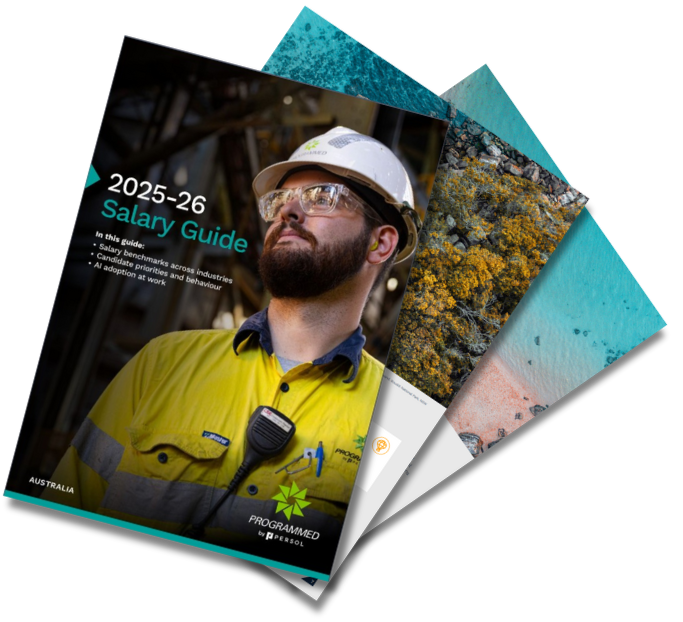
Know the Market Rate
Whether you’re comparing job offers or benchmarking pay for your workforce, the 2025-26 Salary Guide covers current rates across Australian trades and industrial roles.
Download the 2025-26 Salary Guide →