Fixed-Term Contract Limits Under New Fair Work Rules: What Employers Must Do
From 6 December 2023, new rules under the Fair Work Legislation Amendment (Secure Jobs, Better Pay) Act 2022 impose hard limits on fixed-term employment contracts. If your business uses fixed-term arrangements — even occasionally — these changes affect you directly. This article covers what the rules require, which exceptions apply, and what employers commonly get wrong.
What Changed and When
The fixed-term contract provisions came into force on 6 December 2023. They apply to new fixed-term contracts entered into on or after that date. Contracts already in place before that date were not immediately captured, but any renewal or extension after the commencement date is subject to the new rules.
The changes introduced three core requirements.
The Three Core Rules
1. Maximum two-year duration
A fixed-term contract — including any extensions or renewals — cannot run for more than two years in total. A contract for 18 months that is then extended by 8 months would breach this limit. The two-year cap applies to the total period of employment under that contract, not the original term alone.
2. Anti-avoidance — no back-to-back contracts for the same role
You cannot issue a new fixed-term contract to the same employee for the same or substantially similar role immediately after — or shortly after — a previous fixed-term contract ends. The legislation is specifically designed to prevent employers from stringing together successive fixed-term contracts as a way of avoiding permanent employment obligations. If a previous contract existed and the work is substantially the same, the new contract may be treated as an ongoing arrangement regardless of how it’s labelled.
3. Fixed Term Contract Information Statement
Employers must give every new fixed-term employee a Fixed Term Contract Information Statement (FTCIS) before or at the time of entering the contract. This is a Fair Work Ombudsman document — you cannot substitute your own version. Failure to provide it is a compliance breach in its own right, separate from whether the contract itself is compliant.
Exceptions: When Fixed-Term Contracts Beyond Two Years Are Still Permitted
The rules include several specific exceptions. An arrangement that qualifies as an exception is not subject to the two-year cap or the anti-avoidance provisions. The main exceptions are:
- High-income employees: Employees earning above the high-income threshold set by the Fair Work Commission (currently $175,000 per annum, indexed annually) are exempt from the fixed-term limits.
- Specific task or project contracts: If the contract is for a specific task or project that has a defined end point not determined by the passage of time alone, it may qualify. The task or project must be genuinely bounded — “until the project concludes” rather than an open-ended arrangement given a project label.
- Training arrangements: Contracts directly linked to a training arrangement — apprenticeships, traineeships — are excluded.
- Seasonal work: Work that is regular and seasonal in nature — and where the engagement is genuinely tied to that season — qualifies for an exception.
- Emergency and temporary cover: Contracts to cover another employee who is absent (on parental leave, extended sick leave, etc.) are excluded, provided the contract is genuinely tied to the period of absence.
- Positions funded by government program or grant: Where a role exists only because of identified external funding with a defined end, this may qualify — but the funding structure must genuinely dictate the term.
Exceptions are narrower than they appear. If you’re relying on the specific-task or project exception, document clearly what the task or project is, what triggers its conclusion, and why the role does not extend beyond it.
Practical Implications for Employers
The most common problem is accumulated fixed-term engagements that predate December 2023 — roles that have been renewed multiple times and where the business assumes continuation is fine because it “has always been done this way.” That assumption is now a compliance risk.
Employers should audit their current fixed-term arrangements and identify any that are within 12 months of the two-year cap, any that involve recent renewal of contracts for the same role and same employee, and any where the FTCIS was not provided at commencement. For roles where you cannot justify an exception and the two-year limit is approaching, you need to decide: convert to permanent employment, end the engagement genuinely, or obtain legal advice on whether an exception applies.
See our article on labour hire licensing obligations for employers and same job same pay rules for related compliance considerations.
How Labour Hire Differs From Fixed-Term Employment
Labour hire is a separate employment model and operates differently. When you engage workers through a labour hire provider, those workers are employees of the provider — not of your business. Your engagement with the provider is a commercial services arrangement, not an employment contract. The fixed-term contract rules under the Fair Work Act apply to employment relationships — they do not govern the commercial terms between you and your labour hire provider.
This distinction matters. If you need workforce flexibility without navigating fixed-term compliance obligations, labour hire provides a legally distinct alternative. The provider employs the workers, manages their entitlements and handles employment law compliance. Your obligations relate to the host employer’s WHS duties and, under the same job same pay rules, ensuring the provider is paying at the correct rate. Learn more about the managed skilled workforce model and how it differs from direct fixed-term hiring.
Related reading
Also see: Casual Conversion Under Fair Work: What Employers Need to Do.
For a closely related guide, read Using Labour Hire for Workforce Continuity: How to Plan for Disruption.
Related services
FAQ
Does the two-year limit apply to the total duration including all extensions?
Yes. The two-year maximum applies to the total period of employment under fixed-term contracts for the same or substantially similar role — including any extensions or renewals. A contract that starts at twelve months and is extended twice does not reset the clock.
What counts as a ‘specific task or project’ exception?
The exception applies where the contract is genuinely for the duration of a specific task or project that has a defined end point independent of the employer’s preference. Ongoing operational roles with no defined end point do not qualify. The exception is assessed on the actual nature of the work, not the label in the contract.
Do the fixed-term rules apply to casual employees?
No. The fixed-term contract provisions apply to fixed-term employment arrangements — they do not apply to casual employment, which is governed by separate rules including the casual conversion framework.
What is the Fixed Term Contract Information Statement?
It is a document that employers must provide to employees engaged on a fixed-term contract. Like the National Employment Standards Information Statement and the Casual Employment Information Statement, it outlines the employee’s rights and the relevant rules. The Fair Work Ombudsman publishes the current version on its website.
Next step
If you need help reviewing your workforce model or exploring alternatives to fixed-term employment, explore managed skilled workforce solutions.
General information only: This article is for general informational purposes only and does not constitute legal advice. Legislation varies by state and territory — consult a qualified employment lawyer or Fair Work adviser for guidance specific to your situation.
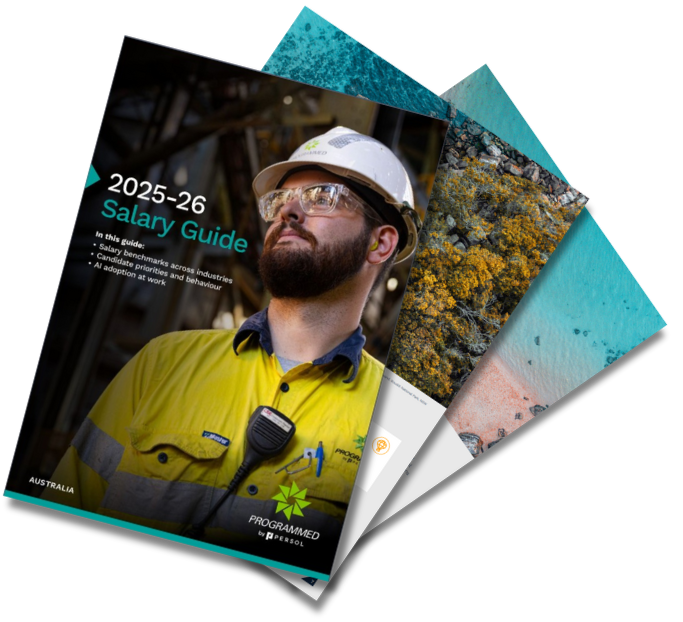
Know the Market Rate
Whether you’re comparing job offers or benchmarking pay for your workforce, the 2025-26 Salary Guide covers current rates across Australian trades and industrial roles.
Download the 2025-26 Salary Guide →