Trades Career Progression: From Site Worker to Supervisor and Beyond
Most tradespeople focus on getting qualified and getting work. Fewer think deliberately about what the path forward looks like after that. This article maps out the realistic career trajectory in trades — what each step actually requires, where labour hire fits in, and what to do if you want to move into supervisory or management roles.
The Realistic Career Path in Trades
Career progression in trades isn’t automatic with years served. It requires demonstrated competency at each level, and often specific additional qualifications or experience that doesn’t come from doing the same job for longer.
Apprentice
The entry point. You’re working under supervision, completing structured training through a Registered Training Organisation (RTO) and building practical competency toward your trade certificate. Duration varies — typically three to four years depending on the trade and jurisdiction. The goal is completing your Certificate III and obtaining your trade licence where required.
Qualified tradesperson
You hold your trade licence and work independently within your scope. This is where most tradespeople spend the bulk of their career. To progress further, you need more than technical competency — you need exposure to different site environments, the ability to plan and sequence work, and eventually the capacity to manage others. Neither of these come from working the same site indefinitely.
Leading hand
The first step into responsibility for others. A leading hand typically coordinates a small crew — two to five people — within a defined work scope. You’re still hands-on, but you’re also responsible for allocating tasks, managing workflow and being the first point of escalation for your crew. This role requires trust from the site supervisor and a track record of reliable, quality work. It’s rarely a formal promotion — it often starts informally and then gets recognised.
Supervisor
Site manager and beyond
Site managers take ownership of an entire work site or project section — planning, resourcing, client management, safety reporting and cost control. Project managers operate at a higher level still, coordinating multiple sites, scopes and stakeholders simultaneously. Both typically require experience across a range of project types, often some formal project management training, and a track record of successful delivery under commercial pressure. Some tradespeople also move into business ownership at this point — running a contracting company or establishing a specialist subcontracting operation.
How Labour Hire Fits Into Career Progression
Labour hire is often treated as a fallback — something you do between permanent jobs. That framing is wrong, and it costs people years of development time.
Working through a labour hire provider gives you access to multiple sites, multiple industries and multiple supervisors in a compressed timeframe. A tradesperson who spends five years at one site has deep familiarity with one set of procedures, one culture and one way of doing things. A tradesperson who has worked across ten sites in five years — different industries, different scales, different safety systems — has a breadth of exposure that’s genuinely difficult to replicate any other way.
That breadth is valuable for progression because supervisory and management roles require you to adapt systems and approaches to different contexts. If you’ve only ever worked one way, adapting is harder. For more on what labour hire work involves, see how labour hire works for jobseekers and our guide on how to get a labour hire job in Australia.
The Role of Additional Tickets and Short Courses
Additional tickets unlock roles that your base trade licence alone won’t. For trades workers looking to move into higher-value or more specialised roles, consider which of these are relevant to your trade and target sector:
- Rigging and dogging licences (required for many heavy-lift and resources roles)
- Elevated Work Platform and scaffolding tickets
- Confined space entry and gas testing
- Hazardous area certification (essential for oil and gas, chemical processing)
- Verification of Competency (VOC) for plant and equipment common on specific sites
- First aid and CPR (required for supervisory roles on many sites)
- Certificate IV in Work Health and Safety (strengthens a supervisory application significantly)
Not all of these cost a lot. Several can be completed in a day or two. The return on investment from a single ticket that unlocks a higher-pay tier or a new industry is often significant relative to the cost.
How to Signal Readiness for Progression
Waiting to be noticed rarely works. Here’s what actually moves the needle when you want to step up:
- Tell your labour hire consultant explicitly that you’re targeting supervisory roles. They place people in those roles and they need to know what you want.
- Ask for placements that involve leading hand responsibility, even informally. The experience matters more than the title at this stage.
- Document what you’ve done — sites you’ve worked, plant you’ve operated, crews you’ve coordinated. Supervisors and project managers can’t advocate for you if they don’t know your history.
- Seek out a senior tradesperson or supervisor on site who’s willing to give you honest feedback. Ask specifically what you’d need to demonstrate to be considered for their role.
What Supervisory Roles Actually Involve
Many site workers underestimate what a supervisory role involves until they’re in one. The technical component drops significantly. Most of the job is:
- Managing competing priorities under time and cost pressure
- Having difficult conversations with crew members about performance, attendance or behaviour
- Writing reports, completing toolbox talks and maintaining safety documentation
- Coordinating with other trades and departments without direct authority over them
- Being accountable for outcomes you don’t fully control
If those things appeal to you, the path is worth pursuing. If they don’t, it’s equally valid to become a highly specialised, highly valued tradesperson without moving into management. Not every career path points upward into paperwork.
Related reading
For a closely related guide, read How to Get a Labour Hire Job in Australia: Steps, Pay and What to Expect.
Related services
FAQ
Do I need a formal qualification to move into a supervisory role?
Not always, but it helps. Demonstrated experience leading a small crew or managing a section of work is often more influential than a certificate in the short term. Longer term, a Certificate IV in Leadership and Management or a relevant site supervisor qualification can strengthen your case for more senior roles.
How does labour hire experience help career progression?
Working across multiple sites and industries through labour hire exposes you to different supervisory styles, safety cultures and work methods faster than staying in one place. Employers and recruiters recognise workers who have performed well across varied environments — it signals adaptability and resilience, both of which matter in supervisory roles.
What is the difference between a leading hand and a supervisor?
A leading hand typically coordinates a small crew’s daily work without full supervisory responsibility — they are often still on the tools themselves. A supervisor carries accountability for the crew’s output, safety compliance and performance, and is usually off the tools at least part of the time. The distinction matters for pay and for what you are expected to manage.
When should I tell a recruiter or employer I want to progress?
As early as it is genuine. Consultants and site managers who know you are aiming for a leading hand or supervisory role will look for opportunities to put you in those situations. Waiting until you feel fully ready usually means waiting too long — progression happens through doing, not just preparation.
Next step
If you are looking for your next role or want support planning your trades career path, explore staffing services.
General information only: This article is for general informational purposes only and does not constitute legal advice. Legislation varies by state and territory — consult a qualified employment lawyer or Fair Work adviser for guidance specific to your situation.
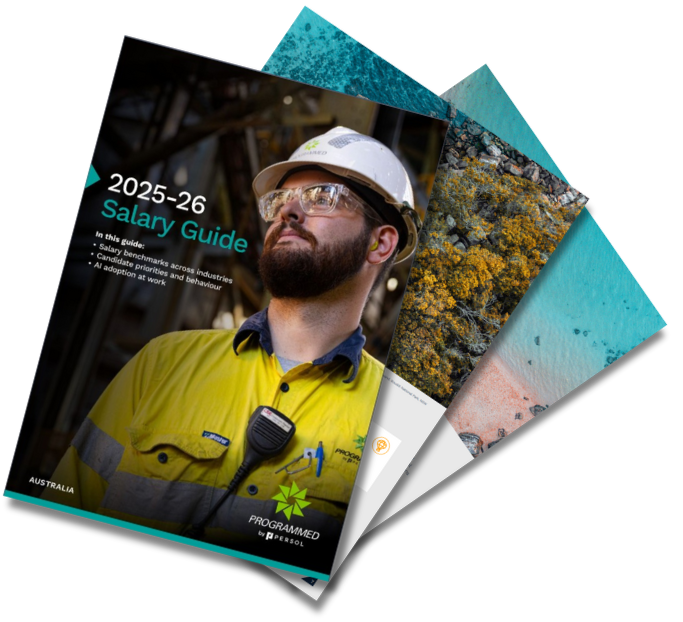
Know the Market Rate
Whether you’re comparing job offers or benchmarking pay for your workforce, the 2025-26 Salary Guide covers current rates across Australian trades and industrial roles.
Download the 2025-26 Salary Guide →