Rail is one of the few industries where workforce planning is directly governed by safety law. The competency of every person working on or near the operational rail corridor — from train drivers to track maintainers — is a regulated matter, not just an HR one. Get it wrong and the consequences extend well beyond a contractor dispute.
For employers and project managers sourcing labour for rail infrastructure, this regulatory weight changes how recruitment, onboarding and workforce management work in practice. Understanding what makes rail different is the starting point for planning a compliant and functional site workforce.
Programmed Skilled Workforce provides labour hire specifically configured for the rail sector, including Rail Safety Worker accreditation tracking, medical management and safety induction coordination. View our staffing services to see how we support rail project teams.
Key takeaways
- Rail Safety Worker (RSW) accreditation is a legal requirement for safety-critical roles under the National Rail Safety Law — it sits above standard trade or competency qualifications.
- Labour hire providers placing workers on rail corridors must manage RSW accreditation, medical fitness and drug and alcohol compliance as part of the placement, not as afterthoughts.
- Major rail infrastructure projects require a different workforce planning model to BAU rail operations — FIFO logistics, sequential induction and surge capacity all need to be built into the plan early.
Why rail workforce planning is different
Most infrastructure sectors manage workforce competency through a combination of trade licences, site inductions and WHS compliance. Rail adds a layer that sits above all of that: a nationally harmonised safety regulatory framework that governs who can perform safety-critical work on the rail corridor, and under what conditions.
The National Rail Safety Law (NRSL), adopted in most Australian states and territories, establishes obligations for rail transport operators and those working within the rail safety management system. The Rail Industry Safety and Standards Board (RISSB) develops the standards and codes of practice that sit beneath the law. State-based rail safety regulators — including the Office of the National Rail Safety Regulator (ONRSR) — oversee compliance and accreditation.
This framework means that a rail project cannot simply source competent tradeworkers from the open market and put them to work. There are mandatory qualification, medical and accreditation steps that must be completed before a worker can perform safety-critical functions on the rail corridor.
Safety-critical roles: what qualifies
Under the NRSL, a Rail Safety Worker (RSW) is any person who carries out rail safety work — defined as work that, if not carried out properly, could jeopardise the safety of rail operations. The RSW classification covers a broad range of roles, including:
- Train drivers and traction staff
- Track workers performing on-track or near-track activities
- Signal maintainers and control room operators
- Rolling stock maintainers working on operational assets
- Network control and possession management roles
Each role category carries specific competency requirements defined by the relevant rail transport operator’s safety management system. Medical fitness requirements are also role-specific — train drivers face the most stringent standards, including periodic health assessments aligned to ONRSR’s medical standards, while track workers typically require fitness-for-work assessments focused on physical capacity and fatigue risk.
Rail Safety Worker accreditation: how it works
RSW accreditation is not a single national licence. It is granted by the rail transport operator (the network owner or manager) against their own safety management system, within the framework set by the NRSL. A worker accredited as an RSW by one rail transport operator is not automatically accredited by another — cross-recognition exists in some cases but cannot be assumed.
For labour hire providers, this creates a specific obligation. When placing a worker in a safety-critical rail role, the provider must confirm that the host rail transport operator’s accreditation requirements have been met — or that the worker will be put through the required process before being deployed on the corridor. Providers who place workers without verifying RSW status are exposing themselves and the client to regulatory risk under the NRSL.
Managing RSW accreditation across a workforce of dozens or hundreds of workers — each with different competency expiry dates, medical review cycles and site-specific authorisations — requires purpose-built workforce management systems, not spreadsheets.
Drug and alcohol obligations in rail
Rail safety legislation imposes drug and alcohol management obligations that go beyond what is required under general WHS law. The NRSL requires rail transport operators to have drug and alcohol management programs in place, and these programs must apply to all RSWs — including those sourced through labour hire arrangements.
This means both the labour hire provider (as the employer of record) and the host rail transport operator have obligations relating to D&A compliance for placed workers. Pre-employment testing, random on-site testing, post-incident testing and return-to-work requirements are all standard in the rail sector, and cutoff thresholds are set by the operator’s program in accordance with Australian Standard AS/NZS 4308. For a detailed breakdown of rail D&A obligations and how positive test outcomes are managed, see our companion article on drug and alcohol testing in rail and resources.
FIFO and regional rail projects
Major rail infrastructure projects — suburban rail loops, inland freight corridors, regional network upgrades — typically operate in locations that cannot be serviced from the local labour market alone. Fly-in fly-out and drive-in drive-out arrangements are common, and they introduce workforce planning considerations that go beyond the regulatory framework.
Mobilisation sequencing matters in rail more than in most sectors. A worker cannot simply arrive on site and begin work — RSW accreditation verification, site-specific induction, possession planning integration and fatigue management requirements all need to be satisfied first. Projects that underestimate the lead time for getting workers to a productive, compliant state on a rail corridor routinely face programme delays.
The workforce planning requirements for major project mobilisation are covered in detail in our guide to mining and resources mobilisation — many of the same sequencing principles apply in rail. For transport-adjacent workforce considerations, the transport workforce planning guide covers fatigue management and licensing frameworks that intersect with rail operations.
What a specialist rail labour hire provider does differently
The difference between a general labour hire provider and one with genuine rail sector capability comes down to what happens before a worker arrives on site. A specialist provider manages the following as part of the placement process — not as extras the client has to chase:
- Verification of RSW accreditation status against the specific host rail transport operator’s requirements
- Coordination of pre-placement medical assessments aligned to the role’s fitness-for-work standard
- Pre-employment drug and alcohol testing completed prior to site access
- Tracking of competency expiry dates, medical review cycles and accreditation renewals across the placed workforce
- Coordination with the host’s safety team on induction sequencing, site access requirements and possession planning integration
The administrative burden of managing these requirements across a large, mobile rail workforce is significant. Providers who do not have systems purpose-built for this tend to shift that burden back to the client’s safety and HR teams — which defeats much of the value of using a managed workforce arrangement.
Related reading
Also see: Defence Industry Labour Hire: Security Clearances, DISP and Workforce Compliance.
Also see: Utilities Workforce Planning: Lineworkers, HV Switching and Infrastructure Trades.
Drug and Alcohol Testing in Rail and Resources: What Employers Must Manage — covers the legal framework, testing types, chain of custody and how positive test outcomes are handled for labour hire workers on rail and resource sites.
Related services
Staffing Services — labour hire and workforce solutions across infrastructure, rail, resources and utilities sectors.
Managed Skilled Workforce — end-to-end workforce management including compliance tracking, medical management and on-site supervision for complex project environments.
FAQ
Does a worker need RSW accreditation before starting a rail labour hire placement?
Yes, for any role that qualifies as rail safety work under the National Rail Safety Law. The accreditation process must be completed — or be underway with the host rail transport operator’s approval — before the worker performs safety-critical functions on the rail corridor. Pre-placement verification is the labour hire provider’s responsibility.
Can RSW accreditation from one rail network be used on another?
Not automatically. RSW accreditation is granted by each rail transport operator against their own safety management system. Cross-recognition arrangements exist in some cases — particularly for track worker competencies — but must be confirmed with the host operator before deployment. Never assume portability.
Who is responsible for managing rail D&A compliance for labour hire workers?
Both the labour hire provider (as employer of record) and the host rail transport operator carry obligations. The host’s site D&A program applies to all workers on the corridor regardless of employment arrangement. The provider is responsible for ensuring pre-employment testing is completed and for managing the employment response to any positive test result.
How far in advance should workforce planning begin for a major rail infrastructure project?
For projects requiring FIFO deployment, RSW accreditation processing and role-specific medical assessments, a minimum of eight to twelve weeks of lead time before the first mobilisation wave is a practical baseline. Projects that start workforce engagement after contract award typically find themselves behind from day one.
Next step
If you are planning a rail infrastructure project or need to build a compliant safety-critical workforce, contact Programmed Skilled Workforce to discuss your project timeline, accreditation requirements and workforce volume. Early engagement gives you the lead time needed to mobilise correctly.
General information only: This article is for general informational purposes only and does not constitute legal advice. Legislation varies by state and territory — consult a qualified employment lawyer or Fair Work adviser for guidance specific to your situation.
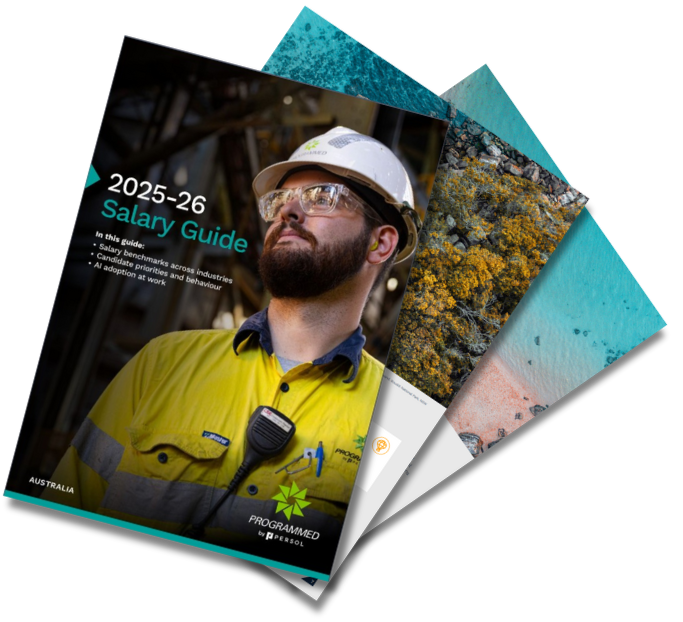
Know the Market Rate
Whether you’re comparing job offers or benchmarking pay for your workforce, the 2025-26 Salary Guide covers current rates across Australian trades and industrial roles.
Download the 2025-26 Salary Guide →